

While we all talk about minor pentatonic soloing, I'm often asked as a guitar teacher of 20+ years: “How do I get out of the pentatonic rut?” My answer is always the same: you don’t want to get away from the pentatonic scale, but rather take what it offers and supplement that with a few well chosen new notes.
So, what are the new notes? Well, they are your chord tones. These are the notes that make up each of the chords in a blues progression. If you want to navigate 'playing the changes', it’s important that you're able to target these chord tones at the right moment. This is how to make your soloing more melodic as more notes are sympathetic to the chords you're playing over.
If you think about the tonality of the minor pentatonic scale it is, obviously, inherently minor-sounding. However, many blues progressions are major chord-based. Sure you can use a few blues curl bends to fudge it, but that's missing the point – good notes played at the right time can't be substituted by styling it out.
Consider a blues in A that features the chords of A7, D7 and E7 – all of these chords contain major triads. This is where the minor pentatonic can start to grate as some notes will work for some of the chords, sometimes. By knowing when these chords occur in a 12 bar blues and the notes contained in them, the more likely you'll sound melodic and able to 'tell a story'.
So with consideration of great melodic bluesers like B.B. King, Peter Green and SRV, I’ve chosen to break the 12-bar blues down into bite-sized chunks, which makes it much easier to appreciate the structure.
To start off, listen to the backing track below which will provide the context for the following 10 examples. At this point, be especially aware of where the chord changes occur.
Example 1 - Target the roots (2:37 in the video)
The first step to 'playing the changes' in a blues context is to confidently target the root note of each chord. Blues is based on a I-IV-V progression, so in the key of A, it would be A7, D7 and E7 with each chord being major with a b7 added.
In each of these licks, you'll play the root note of the chord on the 1st beat of the bar, sometimes bending into the root from a whole tone below, or hammering onto the root from another scale degree. If you play with flow and good phrasing, things start to sound noticeably more melodic, even at this early stage... exciting!
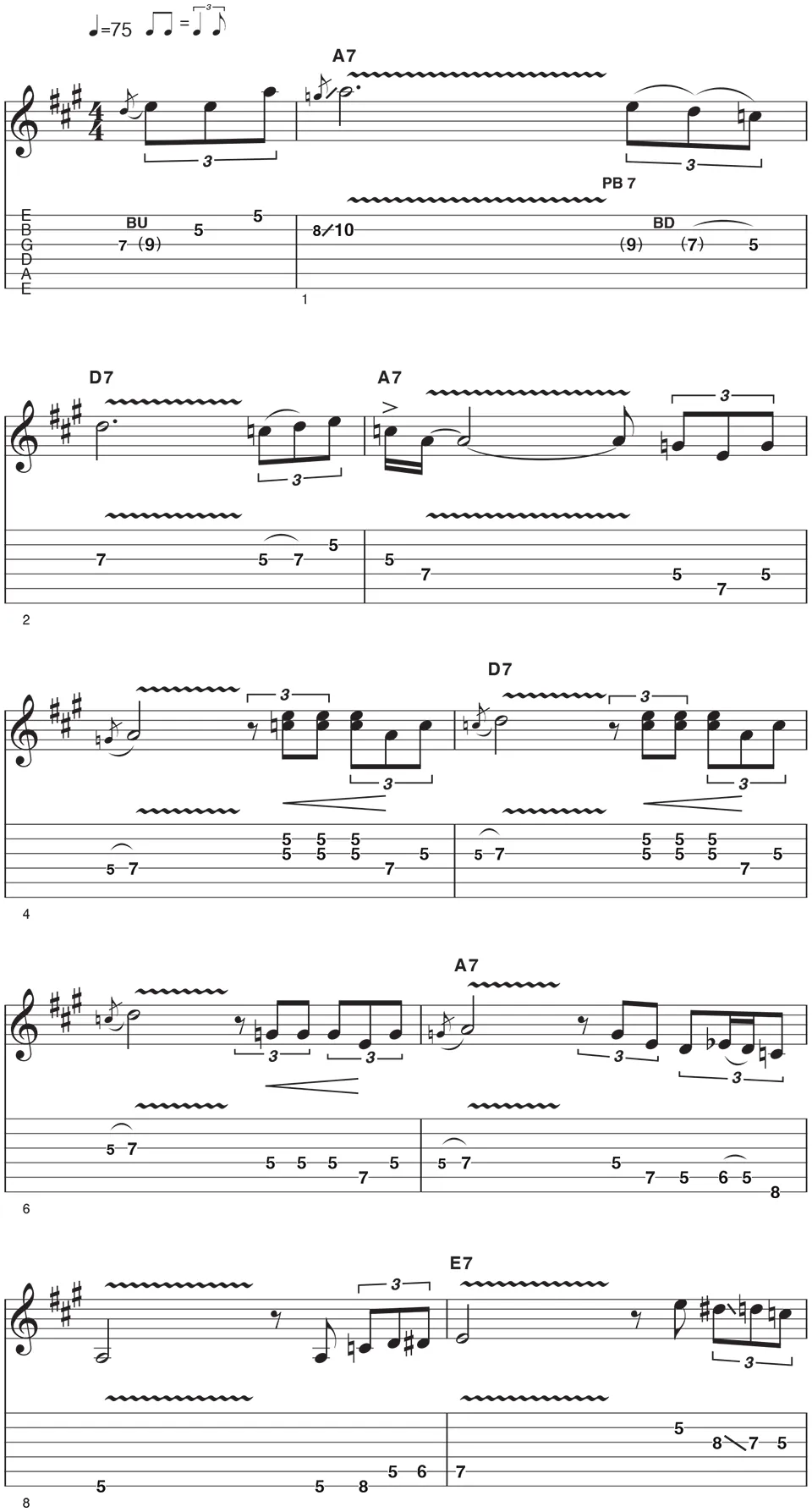

Example 2 - Playing melodies (5:26 in the video)
Here you have a simple bluesy motif that moves between the I and IV chord. This approach to playing helps you create catchy little hooks that are both singable and memorable, less is more!

Example 3 - Chord tones (first four bars) (6:55 in the video)
You are making a point of targeting chord tones here. In order to do this you first need to understand a little about the types of chords you're playing over. These chords are typically either simple power chords, containing just the root and the fifth (eg A5 with the notes A and E), or full-on dominant 7th chords containing the root, 3rd, 5th and b7 (eg A7 with the notes A-C#-E-G).
With the first lick you’re playing over bars 1-4 of the 12-bar blues, so will be targeting the A7 chord tones (A C# E G) in the 1st bar, D7 chord tones (D F# A C) in the 2nd bar, and in bars 3 and 4 you're back to targeting the A7 chord tones. Notice only the A note is shared between both chords.

Example 4 - Chord tones (next four bars) (8:39 in the video)
Expanding on example 3, you can now target the chord tones for bars 4-8 of our 12-bar blues. So it's D7 for two bars, followed by A7 for two bars. Notice the amount of notes played that are derived from these two chords: you're 'playing the changes' with style!

Example 5 - The Blues scale (10:55 in the video)
If you add the b5 (diminished 5th) to the minor pentatonic you get the six note blues scale (R-b3-4-b5-5-b7). This b5 is referred to as the 'blue note' and can add substantial grit and grease to your phrases. For the A blues scale the notes are A-C-D-Eb-E-G.
Here you're playing over bars 5 to 8 of this 12-bar blues in A which results in D7, D7, A7, A7. Over the D7, start by hammering onto the blue note (Eb) from a D note, immediately return to D then off again to C. This a greasy blues lick, that works as well over A7 as it does here over D7.
Tip: the blue note (here, Eb) is often used best as decoration, rather than a note to dwell on.
The phrase is repeated (good blues licks thrive on repetition), before resolving back to the A7 chord via some tasty chord tone double-stops.

Example 6 - Old skool swinging 6ths (13:37 in the video)
This harkens back to the days of swing and jump blues (think T-Bone Walker or Tiny Grimes) by targeting the sixth degree of the scale. In this case, over the A chord, the sixth degree would be F#.
The opening phrase uses this interval across two octaves, before hitting one of my favorite rockabilly double-stops; the 6th (F#) with a b3 (C) on top. Over the D7 chord in bar 2, you'll target its 6th (B) as a note to bend up to the b7 (C). To end, you'll resolve to the A7 chord for bars 3 and 4, where there's liberal use of the sixth interval.

Example 7 - Bending to the right notes (16:18 in the video)
Here are the final four bars of the 12-bar blues: one bar of the V chord (E7), a bar of the IV chord (D7), then a two bar turnaround split between four chords; A7 for two beats, D7 for two beats, A7 for two beats, and then E7 for two beats.
Similar to earlier examples, you’re targeting chord tones over each chord. However, this time you're adding an extra layer of expression by bending into and out of chord notes. This is the next step for more lyrical and natural phrasing.
Important point; listen to how well you bend up to notes, especially when many are sustained such as in bar 2.

Example 8 - Navigating the turnaround (18:05 in the video)
Here you're playing over the final four bars of the 12-bar blues, making a point to efficiently outline the changes for the turnaround. Minimalism is valuable here, as is repetition and being melodic as opposed to more linear scale-based thinking.

Example 9 - Starting well (20:20 in the video)
It’s important that you can grab the attention of your listener right at the start of your solo. Sometimes the best way to do that is to kick the doors down and enter the room with some swagger! Powerful double-stop bends are great for this as well as having a strong vocal-like vibrato.
Good phrasing is key, as is confidence in your note choices. Your audience will be invested in your story from your first musical statement if you get this right.

Example 10 - Ending well (23:22 in the video)
Finishing well is as important as starting well. You want your solo to wrap up in a natural, cohesive way rather than coming to a sudden stop as if the bungee cord just snapped you back to the starting line. Good lead guitarists do just that: they lead the music so make sure you plan ahead and are aware of how and when to finish.
In this example, you'll finish on a powerful strike of an A9 chord after approaching it from a semitone above. It's a classic move you’ll have heard SRV use on many occasions.


