




Guitar World Verdict
If you long for the simpler old-school Rectifier experience, the 90s Triple Rectifier is a love letter to the origins of this legendary amplifier family. With all the right features on-board, and 150 watts of earth-shaking power, Mesa has delivered an impeccably well-made reissue which sounds exactly like it should.
Reasons to buy
- +
Amazing build quality.
- +
Very intuitive layout, but a big feature set too.
- +
The classic Rectifier sounds, just as you remember them.
Reasons to avoid
- -
Seriously expensive outside the US.
- -
With the best will in the world, 150 tube watts is an impractical proposition for most.
You can trust Guitar World Our expert reviewers spend hours testing and comparing guitar products so you can choose the best for you. Find out more about how we test.
What is it?
Following its 1992 debut, Mesa/Boogie’s Dual Rectifier became the definitive rock and metal amps of the 1990s, accumulating countless famous users from nu-metal icons, Korn to Blink-182, Foo Fighters and more.
The Dual Rec was a genuinely new design, taking relatively little inspiration from any previous amp circuit. Its unique sonic identity – plenty of clean headroom, buckets of gain, and chest-rattling low-end thump – and unmistakable tread plate-clad aesthetics, still loom large in the history of rock and metal music.
If you decided, however, that the 100-watt Dual Rectifier was a trifle under-powered, Mesa had the answer – the Triple Rectifier was the same circuit, but with six power valves and 150 watts.
Both the Dual and Triple Rectifier have undergone significant evolution, growing from a two-channel to a three-channel amp, each new evolution incorporating new technical innovations from Mesa’s R&D; it’s always been a case of looking forward, rather than back.
In 2025, however, the original blueprint was dusted off – we now have the first reissues in the thirty-four year history of the range.
Based on the original Dual and Triple Rectifier Solo Heads, the 90s Rectifier Standard models reintroduce the simpler two-channel layout of the early Recs. And today, I have my hands on the full-fat 90s Triple Rectifier Standard – after all, why make do with a mere 100 watts?
Specs
- Launch Price: $3,199 | £3,249 | €3,649
- Type: Tube-powered guitar amp head
- Origin: USA
- Output: 150 watts
- Channels: 2
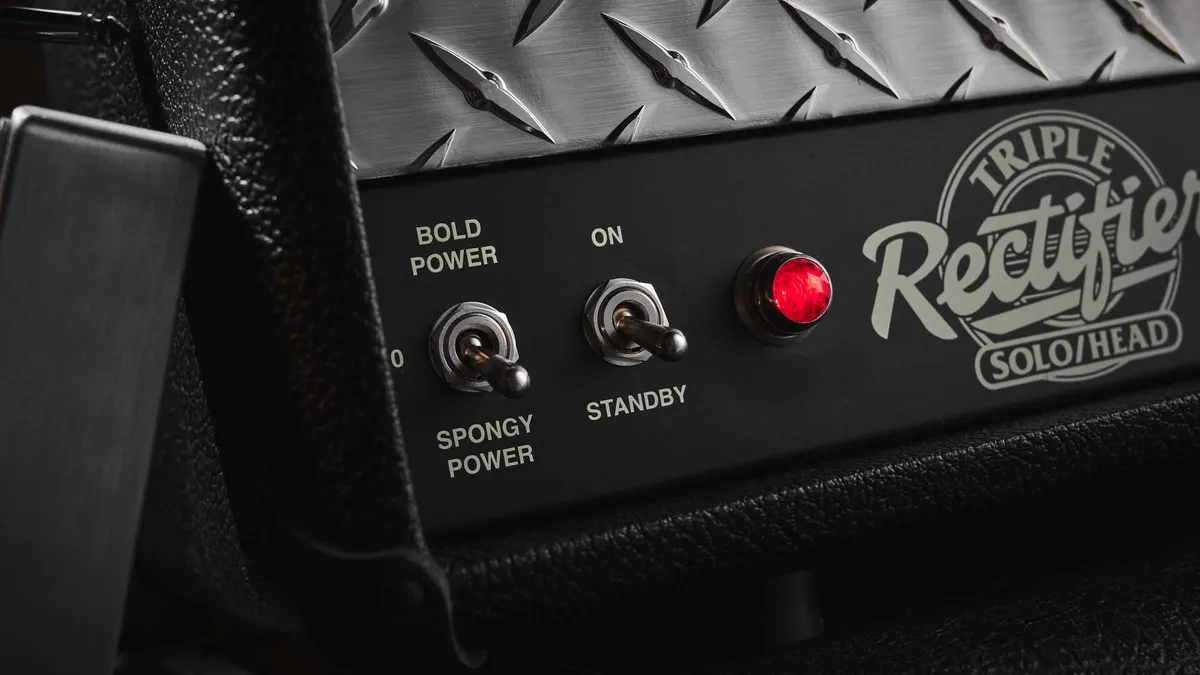
- Controls: Front panel - Gain, Treble, Mid, Bass, Presence and Master per channel. Global Loop Active Master, Standby switch, mains power switch (Bold/Spongy/off)
- Rear panel - Orange/Red Channel select, Orange Channel Gain (Variable High Gain/Clean Rhythm), Channel Style Select (Orange to Modern/Normal/Red to Vintage), Slave Level, Effects Loop selector, Effects Loop Send Level, Bias switch (6L6/EL34), Rectifier Select (Vacuum Tubes/Silicon Diodes)
- Connectivity: Front panel - Instrument input, Footswitch input
- Rear panel - 2x Extension Switch jacks (Chan./Loop), 5x speaker outputs (1x16ohm, 2x 8ohm, 2x 4ohm), Slave Out, Effects Send/Return, mains IEC in
- Footswitch: 1-button Mesa/Boogie footswitch included
- Weight: 22kg/48.6lb
- Dimensions: 648 x 254 x 248 mm
- Contact: Gibson
Build quality

Build quality rating: ★★★★★
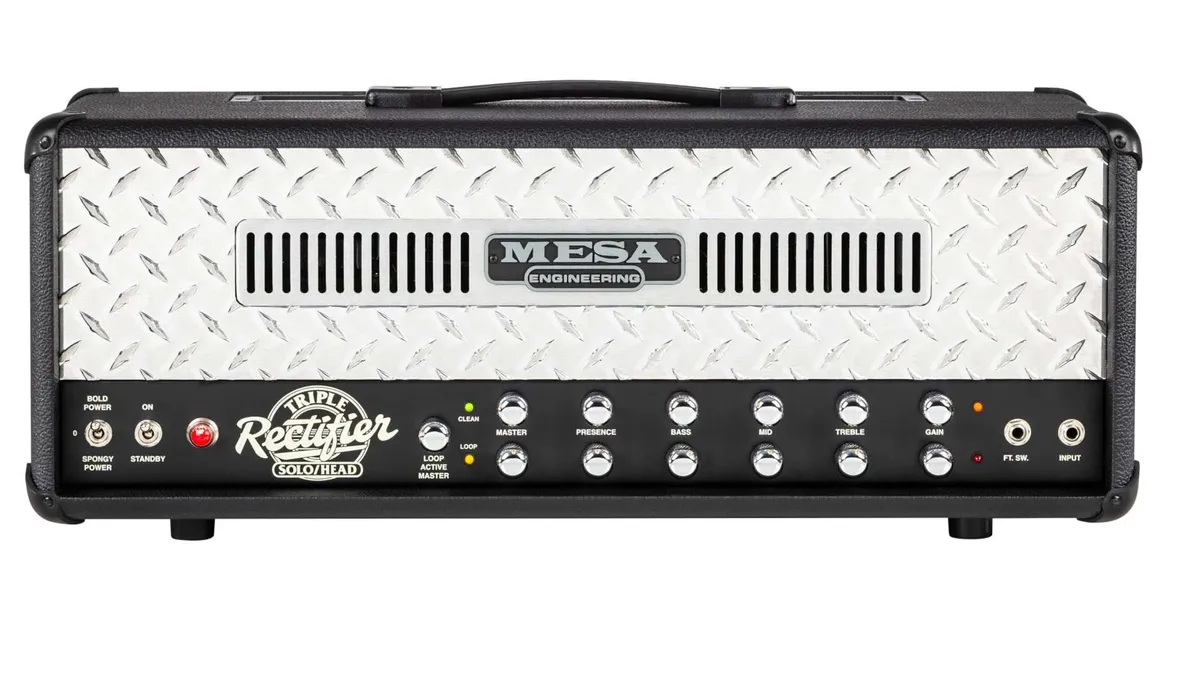
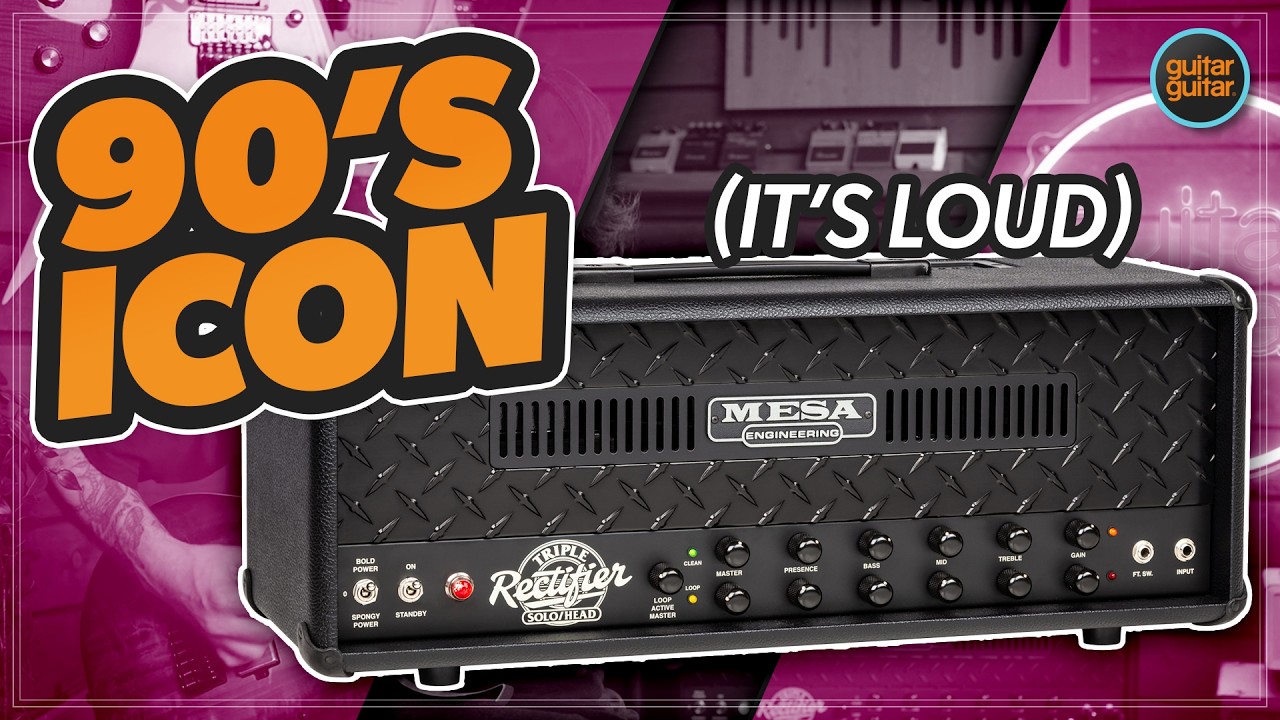
Even purely as a physical object, there’s just nothing like a Rectifier. The hot-rod vented tread plate front and the rows of chrome knobs are evocative but, in person, the sheer solidity is just as impressive.
Mesa always does this well – every pot and switch moves with a well-damped, weighty, deliberate turn or click. It’s expensive (especially in the UK) and, with its massive transformers and milk-float’s worth of glass bottles in the back, it’s certainly no lightweight – but the build is about as good as you could hope to find in an amplifier at any price.
Usability and features

Usability and features rating: ★★★★½
Like most other Mesa amps, the 90s Triple Rectifier is typically well laid out. You could never accuse these amps of lacking features, but it’s remarkably clear and easy to understand how everything works.
Both channels are fully independent, with their own Gain, three-band EQ, Presence and Master volume controls. Then a global master volume, active whenever the effects loop is engaged.

The rear panel, though, bristles with so many features that one might easily be intimidated.
Let’s break it down; comprehensive speaker outputs, jacks for external switching, the effects loop and Level control, the all-important Rectifier Select switch (valve or silicon diode rectification), a Slave output – and two switches that control how the channels work and interact. We’ll come back to those.
Sounds

Sounds rating: ★★★★½
I broke out a trio of guitars – my single-coil James Tyler, a humbucker-equipped Les Paul and an EMG-loaded Ibanez RG (tuned down to drop B). Plugging into a Marshall 1960A cab, I also ran a small selection of effects into the amp's input and effects loop.
Everyone knows Mesa as a purveyor of genre-defining high-gain, but never forget how accomplished it is with clean tones.
No exception here – the high-headroom Triple Rec is superb. There's no reverb, so it can sound dry by itself, but it's an ideal canvas for modulation and delay effects to create huge, modern, shimmering cleans.

Flick one of the aforementioned switches on the rear panel, and the Orange channel offers up Variable High Gain mode – a crunch tone fit for royalty, with a wide range of gain and singing upper-mids.
Combined with the tube rectifier setting and the ‘Spongy’ power setting (lowering the input voltage for a saggier, more compressed sound) it can be a great amp for more classic tones.
These two modes alone will be seriously useful to many, and you can even use the rear-mounted Channel Cloning switch to replace the second channel with this Variable High Gain. But let's face it – most want a Rectifier for its gut-punch distortion.

The Red channel awaits – and doesn’t disappoint. It’s the classic, profoundly aggressive bark, with detailed top-end and breathtaking low-end thump. A lot of Rectifier users (especially those in low tunings) pair it with a Tube Screamer or similar - not so much for extra drive, but to tame that low-end and sculpt the midrange. With my Boss SD-1, this proves highly effective.
Boosted or not, the diode rectification and ‘Bold’ power setting are the natural choice here, providing the sharpest and most aggressive response to complement the EMGs in my low-tuned Ibanez – but I was blown away, too, by the way the Red channel reacted to the three single-coils in my Strat/Tele-hybrid Tyler.

Not only is that upper-end definition even better, it also sounds mind-blowing with the guitar volume rolled back – a wonderful, dynamic and crystalline lower-gain sound, suggesting that you could even use the Rectifier on the Red channel much of the time, controlling the gain with your volume control and picking style.
Verdict

The otherwise identical, 100-watt 90s Dual Rectifier will be plenty (or even excessive) for most, but the Triple offers an extra shot of brutal high-headroom punch
The usual full-size tube head caveats apply when summarizing the Triple Rectifier. In this day and age, it’s an extravagance for most - a glorious one, but an extravagance nonetheless.
There’s so much to be said for the powerfully evocative sound and look of the Rectifier, though – a true icon and, both literally and figuratively, one of the most ‘metal’ amps ever conceived. This new 90s reissue recaptures this in fine style - bringing back everything that made those originals such a resounding success, and serving it up in a box-fresh amp.
The otherwise identical, 100-watt 90s Dual Rectifier will be plenty (or even excessive) for most, but the Triple offers an extra shot of brutal high-headroom punch that some will find irresistible. The build quality is fortress-like, the feature set is strong and very easy to work with, and the sounds are nothing short of magnificent. Get your earplugs in, and enjoy.
Guitar World verdict: If you long for the simpler old-school Rectifier experience, the 90s Triple Rectifier is a love letter to the origins of this legendary amplifier family. With all the right features on-board, and 150 watts of earth-shaking power, Mesa has delivered an impeccably well-made reissue which sounds exactly like it should.
Test |
Results |
Score |
|---|---|---|
Build quality |
Mesa’s build quality remains incredibly solid; it feels like there’s been nothing left to chance with this amp. |
★★★★★ |
Usability and features |
This amp does what it should, very well - but many will struggle to justify choosing this 150-watt behemoth over its (slightly) more practical Dual Rec sibling. |
★★★★½ |
Sounds |
High-gain users will want a Tube Screamer-alike to tame the prodigious low end, but whether clean, overdriven or heavily distorted, it’s a magnificent wall of sound. |
★★★★½ |
Overall |
No, it’s not a practical choice, but the Triple Rec never really has been. This monster among amps is available in its original form again, and that’s cause for celebration. |
★★★★½ |
Also try
Hands-on videos
Doug Doppler Gear x Mesa/Boogie
American Musical Supply

GuitarGuitar
- Best amps for metal 2026: tried and tested metal amps for heavy guitar tones
- “Even after four decades of high-gain amp design evolution, the Mark IIC+’s distortion tones still remain the gold standard”: Mesa/Boogie Mark IIC+ review

