


There comes a point in every long-running band’s career when the unpredictable becomes, well, predictable. For progressive metal titans Periphery, who over the past decade and a half have defined modern djent through a series of records bearing Roman numerals (Periphery I through V), that moment arrived when the group’s members began plotting their newest album.
“We were on tour in Europe, and we all started saying we didn’t want to do another numbered record,” guitarist Mark Holcomb says. “That’s what we’ve always done – Periphery I, II, III, IV, V. It became our shtick, and there was nothing less exciting to us than making Periphery VI.”
Holcomb and his bandmates – fellow guitarists Misha Mansoor and Jake Bowen, drummer Matt Halpern and singer Spencer Sotelo – tossed out fanciful ideas: three EPs released on subsequent weeks, conceptual double albums. Nothing felt right until Halpern said, “Why don’t we write an album about loneliness?” Oddly enough, it was the one idea everybody could get behind.
“It’s such a unique concept for an album,” Holcomb says. “At the same time, it’s a universal feeling, because no matter how happy you are in life, no matter how dissatisfied you may be or anything in between, the experience of feeling lonely, whether it’s embraced or resented, plays a large role in anybody’s life.”
As one might expect, A Pale White Dot isn’t the party record of the year. Songs like Mr. God, Obsession, Subhuman – all of them disturbing, dramatic and ultimately astonishing, full of sophisticated musical crosscurrents and blitzing guitar playing – were born from what Holcomb describes as “band therapy sessions, but not in the Metallica sense.”
Throughout the album, the band explores the darker side of emotional responses and conditions – there’s depression, OCD, anxiety and isolation – and on the record’s best number, Everyone Dies Alone, Holcomb recalls the grief he felt following the recent death of his father. “It’s imagery that I wish I could somehow burn out of my brain, but I know it’ll live with me forever,” he says.

When the band decided to make a concept album, did you reference any of the genre’s biggies? In terms of loneliness and alienation, of course there’s The Wall.
I wouldn’t say we directly referenced them, but as prog nerds we all grew up inhaling concept albums. I’m a big Devin Townsend fan – it feels like most of his records are concept albums. Of course, Dream Theater has made amazing concept albums, as has Opeth and Rush. It’s part of our DNA.
We wanted to stick to a framework but not overthink it. At first glance, or at first listen, if the album sounds down and dark and a little bit dire, it kind of is, because loneliness can be that for most people – not to say that there aren’t moments where it kind of gets turned around and looked at in a positive way. But yeah, it’s a concept record in as much as we can apply that loose term to it.
Not to sound glib, but did the band intentionally restrict themselves to songs that sounded gloomy? What would have happened if you wrote an awesome tune that was a bit on the happier side?
On this album, Misha acquired a 30-inch Jackson Surfcaster baritone guitar with six strings, and he made a 30-second demo of what became Mr. God
That was a situation we ran into many times, actually. I had some ideas that sounded a little more positive, a bit more notey and verbose, as did some of the other guys, but at the end of the day those tunes didn’t match the tone of the record. The fallback was always, “Let’s just store that one.”
We have what we call the Riff Graveyard, where we let riffs and ideas sit in a Dropbox that’s shared by our whole band. We table all of these ideas for our next record or our next-next record, so we always know we’ve got a sizeable stockpile of things to pull from in the future.
I understand you guys used 30-inch scale six-string baritone guitars on the album. Where did that come from?
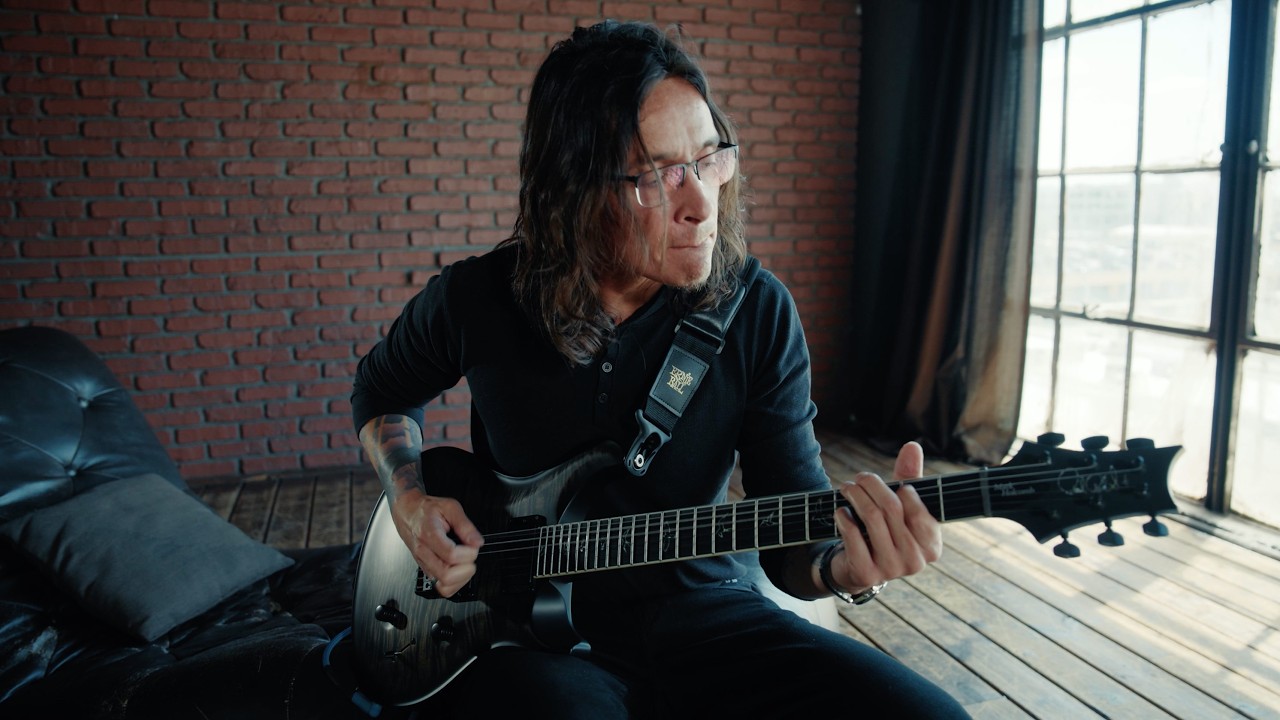
We typically mix things up – songs with six-string guitars, seven-strings, eight-strings. On this album, Misha acquired a 30-inch Jackson Surfcaster baritone guitar with six strings, and he made a 30-second demo of what became Mr. God.
He let me play it, and I was like, “Man, it’s like playing a new instrument.” It doesn’t feel like a guitar. The frets were so wide, so you don’t feel inclined to play leads. Instantly, I was playing patterns that were sparse and didn’t have so many notes, but they had a lot more power.
We tuned the low string down to a B flat, and the fifth string is an octave up, so you get this droning double B flat on the very bottom. When you chug those two low notes, it’s hypnotic. You sit back in your chair and you’re like, “Wow, that’s really heavy.” I had PRS build me a 30-inch guitar, and I used it for a bunch of the record.
So there’s still guitars with seven and eight strings?
Obsession is on a seven-string. Talk is on a six-string in drop C, but the sixth string is tuned down to A. On Subhuman, it’s an eight-string tuned to F standard. We use the eight string on a A Pale White Dot, the acoustic tune at the end of the record – it’s tuned to open Cadd9. We mix it up, man.
Do you guys just tell your guitar techs, “I’m sorry”?
[Laughs] We feel bad constantly. We do say we’re sorry profusely, and I feel horrible for making our guitar techs’ lives miserable!
- A Pale White Dot is out now via 3Dot Recordings.
- This article first appeared in Guitar World. Subscribe and save.

